



Curious Climate schools

Dr Chloe Lucas

Affiliation
School of Geography, Planning, and Spatial Sciences, University of Tasmania
Research Areas
Social adaptation to climate change, climate change communication, social responses to climatic disasters including bushfire and flood.
Why I do what I do
I want to help people understand and adapt to climate change - and for me that means working together, listening to one another, and making collective decisions.
Something interesting about me
I once lived on a beach made almost entirely of hermit crabs.

Questions answered by this expert

Will Penguin ever become tropical?

View Answer

Penguin won’t become tropical anytime soon, but its climate has changed a lot over geological timeframes. Unlike human history, which is recorded in years, decades, and centuries, geological time operates on a scale of millions and billions of years.

Penguin 50 Million Years Ago

Tropical zones are near the Equator. Tasmania has not been in that part of the planet for hundreds of millions of years. In fact, 50 million years ago, it was further south, and attached to Antarctica! But, at that time, the land that is now Tasmania so warm it was covered in lush rainforests, and home to crocodiles and early marsupials. Why?

  • Super-high levels of Greenhouse Gases: Volcanoes had been erupting for a long time, pumping massive amounts of carbon dioxide (CO2) into the air. This acted like a thick blanket around the Earth, trapping in heat.
  • No Polar Ice: It was so hot that there was no ice at the North or South Poles.
  • Warm Ocean Rivers: Because Australia hadn't broken away from Antarctica yet, warm ocean water from the Equator could flow straight down south, acting like a giant heater for Tasmania.

Penguin 30 million years in the future

The Earth is made of lots of tectonic plates that fit together forming the Earth’s crust. They float about on top of a layer of molten rock. The tectonic plate that includes entire Australian continent is drifting north-east, toward the Equator at about 7 centimetres every year. Penguin would need to travel over 2,000 kilometres to reach the tropics. At its current speed, it will take about 30 million years to finally arrive.

Penguin in 50 years

NASA satellite image of Tasmania

We don't have to wait millions of years to see the climate of Tasmania change. Because humans are burning fossil fuels, CO2 is rising again, and the climate is warming up. If countries around the world stick to their current promises to cut pollution, Tasmania's climate won't become a tropical jungle, but it will look different:

  • Warmer and Drier: Temperatures will heat up by about 2-3 degrees on average. Snow and frost will become rare.
  • Tropical Visitors: The ocean currents from the north are already pushing warmer water down. This means tropical fish and sea creatures are moving into Tasmanian waters.
  • More Extreme Weather: Instead of a tropical paradise, Tasmania will likely see more intense bushfire seasons, longer droughts, and sudden, heavy rainstorms.

So, while Tasmania won’t be tropical any time soon, the climate is warming up fast.

Will diseases come from icebergs / glaciers that are melting in Antartica? We think this because they may be trapped, as gases, in the glaciers and when scientists return to Tassie from Antartica, they may bring them back.

View Answer

Luckily, we can say no, dangerous diseases will not escape from melting Antarctic icebergs to infect people, and scientists will not accidentally bring them back to Tassie.

Antarctic ice is clean

When snow falls in Antarctica and gets squashed into solid glacier ice over thousands of years, it does trap tiny bubbles of ancient air. Scientists actually drill out these ice cores to sample the ancient air and see what the atmosphere was like millions of years ago! Antarctica is an isolated continent covered almost entirely by pure, clean ice. Because humans and land mammals have never really lived across the frozen interior of Antarctica, there are simply no human diseases frozen in its glaciers waiting to be released.

Diseases can be released from Arctic permafrost

You might have heard about permafrost melting and releasing ancient diseases and bacteria. Permafrost is frozen, ancient soil, and in the Arctic (the North Pole), it can contain the bodies of ancient animals like mammoths. Permafrost is melting in the Arctic, but not in Antarctica (the South Pole). So while there is a risk of long-frozen diseases coming back in the Arctic, Antarctica is safe from these.

Antarctic scientists have strict rules to avoid spreading diseases

Scientists travelling to Antarctica are very careful not to spread diseases while they are there, and not to bring them back. One disease that Antarctic scientists are worried about is Bird Flu. This disease is affecting birds and animals in every continent except Australia and Antarctica. Some early signs have been found in Antarctica. Scientists who visit Antarctica have to wear protective equipment, disinfect all their equipment between sites, and never sit or kneel on the ground near wildlife.

What is coral bleaching?

View Answer

Coral reefs - like Australia’s Great Barrier Reef - can be so big you can see them from space. But they are made of very tiny animals called coral polyps. Each tiny coral polyp makes a small, solid cup of calcium carbonate around its body. Coral polyps live stuck together in enormous colonies called reefs.  Inside each tiny coral polyp are even tinier algae that act like helpers. These algae give coral their bright colours and help them make food using sunlight, so they can grow and stay healthy. Coral and algae work together as a team.
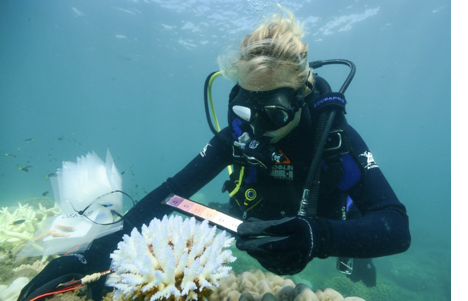
An AIMS Scientist measuring bleached coral. Photo: Eric Matson

When the ocean water gets too warm, the coral become stressed. To cope, they push out their algae helpers. Without the algae, the coral lose their colour and turn white—this is called coral bleaching. Bleached coral are not dead straight away, but they are weaker and have less energy.

If the water cools down soon enough, the algae can come back and the coral can recover. But if the heat lasts too long, the coral may die. This is a big problem because many sea animals depend on coral reefs for food and shelter, and people depend on reefs too. Climate change is making the oceans warmer, which is why coral bleaching is happening more often.

You can find out more about coral bleaching on the Australian Institute of Marine Science website.

Why are there more bushfires?

View Answer

Dr Chloe Lucas explains how climate change leads to more frequent and intense bushfires.

Why do people continue to pollute the earth, even though it harms the earth?

View Answer

How can we get people to care about climate change?

View Answer

1 2 3 4
climateFuturesUnviersity of TasmaniaTas Gov Sponosored
We acknowledge the Palawa/Pakana people, the Traditional Custodians of lutrawita/Tasmania. We recognise and respect their collective wisdom and knowledge about country and change.
(c) copyright 2026 University of Tasmania.
About this site
closearrow-circle-o-downchevron-downkeybarsellipsis-v