Penguin District School Year 7

Our Questions
If sea levels keep rising how many years would it take for all the land to be submerged?
View Answer

If the ice keep melting what will happen to animal like polar bears?
View Answer
Climate change is an ongoing issue that is impacting all species across the planet. With warmer weather both on land and in the water, many different animals are becoming stressed in their environments or even losing their homes. I am from Canada, and one species that we worry about coming extinct is the beautiful polar bear (Ursus Maritimus). They live way up north in the arctic, and they are facing a very uncertain future as warmer temperatures are significantly impacting their icy habitat. As the summers get longer and warmer, the sea ice is melting quickly and not re-forming fast enough to allow the bears to have access to hunt seals. This is causing lots of bears to go hungry, which is a direct result of the warm temperatures from the effects of climate change.

A little bit closer to your home, another species that is impacted by the changing climate is the koala (Phascolarctos Cinereus). These cute, fluffy animals have a special diet of eucalyptus leaves but as carbon dioxide levels rise, the nutritional value of the leaves is decreasing, leaving the koalas malnourished and starving. Furthermore, we are seeing increased droughts and bushfires due to climate change, which will also have severe impacts on the koalas and their environment.

The good news is that some species might have the ability to adapt to climate change, but the real problem is how fast these changes are happening. While all animals will do their best to survive by moving to new locations or finding ways to try to control how their bodies react, not all of them can do it fast enough to keep up. However, one animal that has done an awesome job of dealing with our changing climate is the lungfish! As droughts become more frequent, lots of animals must learn to cope with water shortages. This animal lives in marshes and reservoirs and if the habitats dry up, the lungfish can actually make its bladder function as a lung! For a fish, this is super cool that they have adapted to be able to breathe air during the increasingly-long dry season.

Every species is being impacted by climate change in their own way and what we hope is that they will be able to find a way to survive, and thrive, under these circumstances. However, it is inevitable that some will not. The best thing that we can do is to try to minimize our impacts as humans to reduce the effects of climate change which will hopefully help all these amazing animals around the world!

Can global warming be prevented, and if so, how can we help to do this?
View Answer

Will tsunamis and other natural disasters likely hit Tasmania because of climate change, and if so, when and how frequently do you think this will happen?
View Answer
Tasmania does face a high risk of tsunamis, though these are caused by underwater earthquakes rather than climate change directly. However, rising sea levels caused by climate change do make tsunamis and coastal floods more dangerous because the water starts from a higher level and can reach further inland. Scientists say that what used to be a really big flood that only happened once every 100 years could start happening almost every single year in Tasmania by the end of this century, especially during high tides.
Climate change will also bring other natural hazards to Tasmania more often. Bushfires are expected to become much more dangerous, with fire risk increasing up to 8 times by the end of the century. Heatwaves will become longer and more intense, and storms bringing very heavy rainfall are also expected to increase. The good news is that scientists are already tracking and mapping these risks very carefully, and Tasmania is actually considered one of the safer places in the world because it can grow its own food and generate its own electricity. The Tasmania State Emergency Service website have some great information about how to stay safe if a tsunami warning is ever issued and the State Government Planning Office also have information about protections against other natural hazards.


With sea levels rising how much would floods affect Tasmania would certain islands or parts of the coast get covered in water?
View Answer
Sea levels around Tasmania are expected to rise by around 23 cm by 2050 and up to 85 cm by 2100. That is less than a metre, but it is enough to cause some big problems. Low-lying coastal areas, beaches, wetlands, and parts of estuaries (where rivers meet the sea) could regularly flood. Some islands like Flinders Island and King Island have large areas of low, flat land that could get partly covered by water, especially during storms. Scientists have mapped these risks and found that over 20,000 hectares of Tasmanian coastal land could be affected.

The flooding would not happen all at once like a wave from a movie. It would be more like storms and high tides reaching further and further inland over time. Imagine the biggest storm flood you have ever seen, happening much more often, and reaching places that used to stay dry. Some beaches and coastal towns could regularly go underwater during storms. The good news is that scientists are already making detailed maps to help communities plan ahead and stay safe. You can even explore some of these risks yourself using a free online tool called Canute, made by the CSIRO.
What do you think is going to happen to our planet in the next 100 years if climate change continues in this way (or if nobody was trying to stop it)?
View Answer

If all the ice melts will it eventually freeze back if everyone stops global warming?
View Answer

What is coral bleaching?
View Answer
Coral reefs - like Australia’s Great Barrier Reef - can be so big you can see them from space. But they are made of very tiny animals called coral polyps. Each tiny coral polyp makes a small, solid cup of calcium carbonate around its body. Coral polyps live stuck together in enormous colonies called reefs. Inside each tiny coral polyp are even tinier algae that act like helpers. These algae give coral their bright colours and help them make food using sunlight, so they can grow and stay healthy. Coral and algae work together as a team.
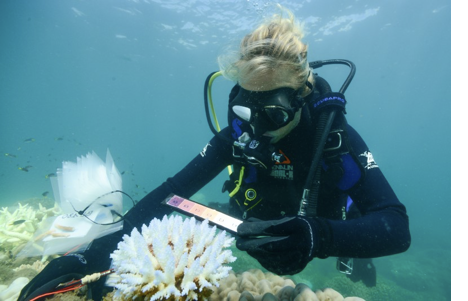
An AIMS Scientist measuring bleached coral. Photo: Eric Matson
When the ocean water gets too warm, the coral become stressed. To cope, they push out their algae helpers. Without the algae, the coral lose their colour and turn white—this is called coral bleaching. Bleached coral are not dead straight away, but they are weaker and have less energy.
If the water cools down soon enough, the algae can come back and the coral can recover. But if the heat lasts too long, the coral may die. This is a big problem because many sea animals depend on coral reefs for food and shelter, and people depend on reefs too. Climate change is making the oceans warmer, which is why coral bleaching is happening more often.
You can find out more about coral bleaching on the Australian Institute of Marine Science website.

With the rise in temperature will we see an increase of skin cancer?
View Answer
Evidence confirms that rising temperatures and skin cancer are linked. When it gets hotter, people naturally spend more time outside wearing less clothing, which means more skin is exposed to the sun's harmful ultraviolet (UV) rays. Researchers have also discovered that heat makes UV radiation more damaging at a biological level. Heat stress stops damaged skin cells from self-destructing as they normally would, allowing harmful cells to survive and potentially turn cancerous. Research shows that skin cancer cases in the US more than tripled between 1975 and 2021, and in Canada, the deadliest form of skin cancer (melanoma) increased by 17% in 2024.
Although it is not directly linked to climate change, the ozone layer plays a critical role in this picture too, because it functions as the Earth's natural ‘sunscreen’. Tasmania sits directly under one of the most ozone-depleted parts of the atmosphere, meaning Tasmanians already receive some of the highest UV radiation levels in the world. Australia as a whole has the highest skin cancer rates on the planet, affecting around 50% of Australians in their lifetime. Tasmania's proximity to the Antarctic ozone hole mean we are particularly exposed. While the Montreal Protocol has slowed ozone damage significantly, scientists estimate full recovery will not occur until around 2060, meaning this elevated UV risk will persist for decades.

The good news is that skin cancer is one of the most preventable cancers, and we know what the protective measures are. Wearing sunscreen daily, covering up with protective clothing, and avoiding peak sun hours between 10am and 4pm all make a meaningful difference. For Tasmanians, the particular risk lies in being caught off guard on cool or cloudy days, where UV radiation can remain dangerously high despite the temperature feeling mild. Consistent sun protection, regardless of how the weather feels, remains the most effective defence.